


Page 54 - 260909_BACnet_Europe-Journal_45
P. 54
BACnet Interest Group Europe News

          Increase Visibility for Building Automation


          with GEO


          Mit GEO die Sichtbarkeit für Gebäude-

          automation steigern


          More and more internet users are receiving direct answers from
          ChatGPT, Perplexity or Google AI Overviews instead of searching
          through lists of results. Generative Engine Optimization (GEO)
          ensures that specialist content becomes visible to these AI
          systems – an interesting topic for BACnet content as well.
          Immer mehr Internet-Nutzer erhalten direkte Antworten von
          ChatGPT, Perplexity oder Google AI Overviews – statt Trefferlis-
          ten zu durchsuchen. Dafür, dass Fachinhalte für diese KI-Systeme
          sichtbar werden, sorgt Generative Engine Optimization (GEO) –
          auch für BACnet-Content ein interessantes Thema.


          For companies in the BACnet community, visibility is a decisive competitive
          factor. Companies that are perceived early on as a competent source
          during digital research increase their chances of being considered at an
          early stage of planning and decision-making processes. In a market with
          long project cycles, many stakeholders and a high need for explanation,
          this early visibility can make all the difference.

          But how do people search for and find information? Today, anyone
          researching  BACnet,  interoperability  or  BACnet/SC  increasingly  starts
          with ChatGPT or Perplexity, or already receives an AI-generated answer
          in Google AI Overviews. The shift can already be measured: According to
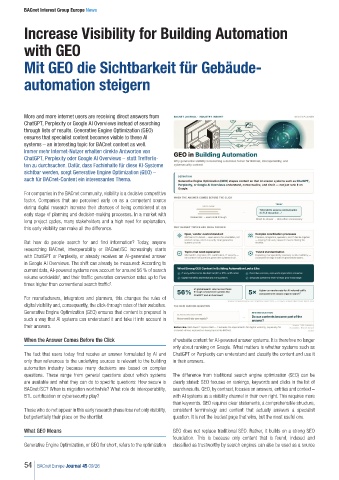
          current data, AI-powered systems now account for around 56 % of search
          volume worldwide , and their traffic generates conversion rates up to five
                      1
                                        2
          times higher than conventional search traffic .
          For manufacturers, integrators and planners, this changes the rules of
          digital visibility and, consequently, the click-through rates of their websites.
          Generative Engine Optimization (GEO) ensures that content is prepared in
          such a way that AI systems can understand it and take it into account in
          their answers.

          When the Answer Comes Before the Click              of website content for AI-powered answer systems. It is therefore no longer
                                                              only about ranking on Google. What matters is whether systems such as
          The fact that users today first receive an answer formulated by AI and   ChatGPT or Perplexity can understand and classify the content and use it
          only then references to the underlying sources is relevant to the building   in their answers.
          automation industry because many decisions are based on complex
          questions. These range from general questions about which systems   The difference from traditional search engine optimization (SEO) can be
          are available and what they can do to specific questions: How secure is   clearly stated: SEO focuses on rankings, keywords and clicks in the list of
          BACnet/SC? When is migration worthwhile? What role do interoperability,   search results. GEO, by contrast, focuses on answers, entities and context –
          BTL certification or cybersecurity play?            with AI systems as a visibility channel in their own right. This requires more
                                                              than keywords. GEO requires clear statements, a comprehensible structure,
          Those who do not appear in this early research phase lose not only visibility,   consistent terminology and content that actually answers a specialist
          but potentially their place on the shortlist.       question. It is not the loudest page that wins, but the most useful one.

          What GEO Means                                      GEO does not replace traditional SEO. Rather, it builds on a strong SEO
                                                              foundation. This is because only content that is found, indexed and
          Generative Engine Optimization, or GEO for short, refers to the optimization   classified as trustworthy by search engines can also be used as a source


          54  BACnet Europe Journal 45 09/26

