


Page 25 - 210922_BACnet_Europe-Journal_35_low
P. 25
Anniversary – 30 years of BACnet Jubiläum – 30 Jahre BACnet
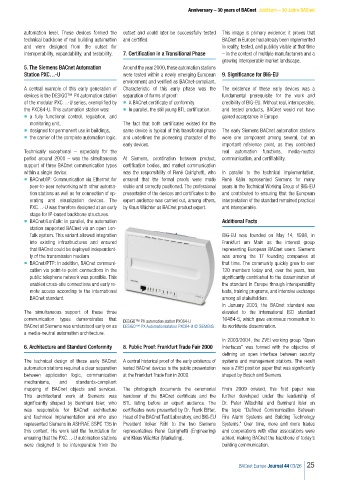
automation level. These devices formed the outset and could later be successfully tested This image is primary evidence: it proves that
technical backbone of real building automation and certified. BACnet in Europe had already been implemented
and were designed from the outset for in reality, tested, and publicly visible at that time
interoperability, expandability, and testability. 7. Certification in a Transitional Phase – in the context of multiple manufacturers and a
growing interoperable market landscape.
5. The Siemens BACnet Automation Around the year 2000, these automation stations
Station PXC…-U were tested within a newly emerging European 9. Significance for BIG-EU
environment and verified as BACnet-compliant.
A central example of this early generation of Characteristic of this early phase was the The existence of these early devices was a
devices is the DESIGO™ PX automation station separation of forms of proof: fundamental prerequisite for the work and
of the modular PXC…-U series, exemplified by A BACnet certificate of conformity. credibility of BIG-EU. Without real, interoperable,
the PXC64-U. This automation station was: n parallel, the still young BTL certification. and tested products, BACnet would not have
I
fully functional control, regulation, and gained acceptance in Europe.
a
monitoring unit, The fact that both certificates existed for the
d
esigned for permanent use in buildings, same device is typical of this transitional phase The early Siemens BACnet automation stations
t
he carrier of the complete automation logic. and underlines the pioneering character of the were one component among several, but an
early devices. important reference point, as they combined
Technically exceptional – especially for the real automation functions, media-neutral
period around 2000 – was the simultaneous At Siemens, coordination between product, communication, and certifiability.
support of three BACnet communication types certification bodies, and market communication
within a single device: was the responsibility of René Quirighetti, who In parallel to the technical implementation,
B
ACnet/IP: Communication via Ethernet for ensured that the formal proofs were made René Kälin represented Siemens for many
peer-to-peer networking with other automa- visible and correctly positioned. The professional years in the Technical Working Group of BIG-EU
tion stations as well as for connection of op- presentation of the devices and certificates to the and contributed to ensuring that the European
erating and visualization devices. The expert audience was carried out, among others, interpretation of the standard remained practical
PXC…-U was therefore designed at an early by Klaus Wächter as BACnet product expert. and interoperable.
stage for IP-based backbone structures.
B
ACnet/LonTalk: In parallel, the automation Additional Facts
station supported BACnet via an open Lon-
Talk system. This variant allowed integration BIG-EU was founded on May 14, 1998, in
into existing infrastructures and ensured Frankfurt am Main as the interest group
that BACnet could be deployed independent- representing European BACnet users. Siemens
ly of the transmission medium. was among the 17 founding companies at
B
ACnet/PTP: In addition, BACnet communi- that time. The community quickly grew to over
cation via point-to-point connections in the 120 members today and, over the years, has
public telephone network was possible. This significantly contributed to the dissemination of
enabled cross-site connections and early re- the standard in Europe through interoperability
mote access according to the international tests, training programs, and intensive exchange
BACnet standard. among all stakeholders.
In January 2003, the BACnet standard was
The simultaneous support of these three elevated to the international ISO standard
communication types demonstrates that DESIGO™ PX automation station PXC64-U 16484-5, which gave enormous momentum to
BACnet at Siemens was understood early on as DESIGO™ PX Automationsstation PXC64-U © SIEMENS its worldwide dissemination.
a media-neutral automation architecture.
In 2003/2004, the ZVEI working group “Open
6. Architecture and Standard Conformity 8. Public Proof: Frankfurt Trade Fair 2000 Interfaces” was formed with the objective of
defining an open interface between security
The technical design of these early BACnet A central historical proof of the early existence of systems and management stations. The result
automation stations required a clear separation tested BACnet devices is the public presentation was a ZVEI position paper that was significantly
between application logic, communication at the Frankfurt Trade Fair in 2000. shaped by Bosch and Siemens.
mechanisms, and standards-compliant
mapping of BACnet objects and services. The photograph documents the ceremonial From 2009 onward, this first paper was
This architectural work at Siemens was handover of the BACnet certificate and the further developed under the leadership of
significantly shaped by Bernhard Isler, who BTL listing before an expert audience. The Dr. Peter Witschital and Bernhard Isler on
was responsible for BACnet architecture certificates were presented by Dr. Frank Bitter, the topic “Defined Communication Between
and technical implementation and who also Head of the BACnet Test Laboratory, and BIG-EU Fire Alarm Systems and Building Technology
represented Siemens in ASHRAE SSPC 135 in President Volker Röhl to the two Siemens Systems.” Over time, more and more trades
this context. His work laid the foundation for representatives René Quirighetti (Engineering) and cooperations with other associations were
ensuring that the PXC…-U automation stations and Klaus Wächter (Marketing). added, making BACnet the backbone of today’s
were designed to be interoperable from the building communication.
BACnet Europe Journal 44 03/26 25

