


Page 16 - 260909_BACnet_Europe-Journal_45
P. 16
Solutions  Anwendungen

          Wireless Sensors in Large BACnet

          Infrastructures: Lessons from Airport


          Deployments


          Drahtlose Sensoren in großen


          BACnet-Infrastrukturen: Erfahrungen


          aus Flughafenprojekten


          As BACnet systems grow in size and
          complexity, the assumptions behind
          conventional sensor network design
          start to break down. Airports make this
          concrete.
          Mit zunehmender Größe und Komplexität
          von BACnet-Systemen stoßen die
          bisherigen Auslegungsprinzipien
          konventioneller Sensornetzwerke an ihre
          Grenzen. Flughäfen verdeutlichen dieses
          Problem besonders anschaulich.

          The Scale Problem in Airport BACnet
          Networks


          Airports  operate  around  the  clock,  span
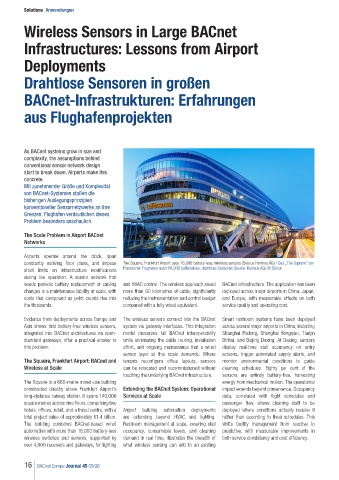
          constantly evolving floor plans, and impose   The Squaire, Frankfurt Airport uses 16,000 battery-less, wireless sensors (Source Hermos AG) / Das „The Squaire“ am
          strict limits on infrastructure modifications   Frankfurter Flughafen nutzt 16.000 batterielose, drahtlose Sensoren (Quelle: Hermos AG) © iStock
          during live operation. A sensor network that
          needs periodic battery replacement or cabling   and HVAC control. The wireless approach saved   BACnet infrastructure. The application has been
          changes is a maintenance liability at scale, with   more than 90 kilometres of cable, significantly   deployed across major airports in China, Japan,
          costs that compound as point counts rise into   reducing the instrumentation and control budget   and  Europe,  with measurable effects on both
          the thousands.                    compared with a fully wired equivalent.  service quality and operating cost.

          Evidence from deployments across Europe and   The wireless sensors connect into the BACnet   Smart restroom systems have been deployed
          Asia shows that battery-free wireless sensors,   system via gateway interfaces. This integration   across several major airports in China, including
          integrated into BACnet architectures via open-  model preserves full  BACnet interoperability   Shanghai Pudong, Shanghai Hongqiao, Tianjin
          standard gateways, offer a practical answer to   while eliminating the cable routing, installation   Binhai, and Beijing Daxing. At Daxing, sensors
          this problem.                     effort, and ongoing maintenance that a wired   display real-time stall occupancy on entry
                                            sensor layer at this scale demands. Where   screens, trigger automated supply alerts, and
          The Squaire, Frankfurt Airport: BACnet and   tenants reconfigure office layouts, sensors   monitor environmental conditions to guide
          Wireless at Scale                 can be relocated and recommissioned without   cleaning  schedules.  Eighty  per  cent  of  the
                                            touching the underlying BACnet infrastructure.  sensors  are  entirely  battery-free,  harvesting
          The Squaire is a 660-metre mixed-use building                        energy from mechanical motion. The operational
          constructed directly above Frankfurt Airport’s  Extending the BACnet System: Operational   impact extends beyond convenience. Occupancy
          long-distance railway station. It spans 140,000  Services at Scale   data, correlated with flight schedules and
          square metres across nine floors, comprising two                     passenger flow, allows cleaning staff to be
          hotels, offices, retail, and a travel centre, with a   Airport building automation deployments   deployed where conditions actually require it
          total project value of approximately €1.4 billion.   are extending beyond HVAC and lighting.   rather than according to fixed schedules. This
          The building combines  BACnet-based wired   Restroom management at scale, covering stall   shifts  facility  management  from  reactive  to
          automation with more than 16,000 battery-less   occupancy, consumable levels, and cleaning   predictive, with measurable improvements in
          wireless switches and sensors, supported by   demand in real time, illustrates the breadth of   both service consistency and cost efficiency.
          over 4,000 receivers and gateways, for lighting   what wireless sensing can add to an existing


          16  BACnet Europe Journal 45 09/26

