


Page 11 - 210922_BACnet_Europe-Journal_35_low
P. 11
Anniversary – 30 years of BACnet  Jubiläum – 30 Jahre BACnet


                                                              construction trade fair in Hanover. With computers placed between roof
                                                              tiles and concrete mixers – this, following a conversation with the fair
                                                              director Sepp Heckmann, was the impetus for CONSTRUCTEC ’94 and
                                                              ’96, whose concept led to Light + Building with the Building Performance
                                                              Congress from 1998 onward. The nomenclature of CONSTRUCTEC was
                                                              Chapter 2.1.13 of the “Building Control” book.

                                                              BACnet is created

                                                              In 1990, before the first public review, Mike Newman renamed the ASHRAE
                                                              protocol to BACnet™ and had the name protected as a trademark for
                                                              ASHRAE.
                                                              Others wanted to name it “ASHnet”… to reduce buildings to ashes?
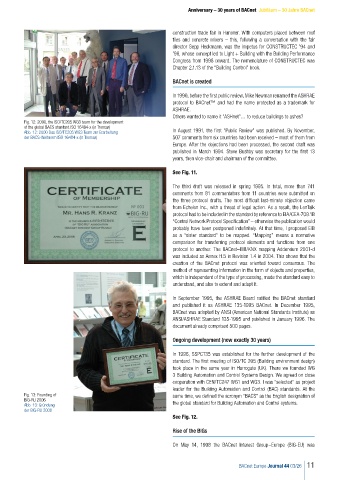
          Fig. 12: 2000, the ISO/TC205 WG3 team for the development
          of the global BACS standard ISO 16484-x (in Tromsø)
          Abb. 12: 2000 Das ISO/TC205 WG3 Team zur Erarbeitung    In August 1991, the first “Public Review” was published. By November,
          der BACS-Weltnorm ISO 16484-x (in Tromsø)           507 comments from six countries had been received – most of them from
                                                              Europe. After the objections had been processed, the second draft was
                                                              published in March 1994. Steve Bushby was secretary for the first 13
                                                              years, then vice-chair and chairman of the committee.

                                                              See Fig. 11.

                                                              The  third  draft  was  released  in  spring  1995.  In  total,  more  than  741
                                                              comments from 81 commentators from 11 countries were submitted on
                                                              the three protocol drafts. The most difficult last-minute objection came
                                                              from Echelon Inc., with a threat of legal action. As a result, the LonTalk
                                                              protocol had to be included in the standard by reference to EIA/CEA-709.1B
                                                              “Control Network Protocol Specification” – otherwise the publication would
                                                              probably have been postponed indefinitely. At that time, I proposed EIB
                                                              as a “sister standard” to be mapped. “Mapping” means a normative
                                                              comparison for transferring protocol elements and functions from one
                                                              protocol to another. The BACnet–EIB/KNX mapping Addendum 2001-d
                                                              was included as Annex H.5 in Revision 1.4 in 2004. This shows that the
                                                              creation of the  BACnet protocol was oriented toward consensus. The
                                                              method of representing information in the form of objects and properties,
                                                              which is independent of the type of processing, made the standard easy to
                                                              understand, and also to extend and adapt it.

                                                              In  September 1995, the ASHRAE Board ratified the  BACnet standard
                                                              and published it as ASHRAE 135-1995  BACnet. In December 1995,
                                                              BACnet was adopted by ANSI (American National Standards Institute) as
                                                              ANSI/ASHRAE Standard 135-1995 and published in January 1996. The
                                                              document already comprised 500 pages.

                                                              Ongoing development (now exactly 30 years)

                                                              In 1996, SSPC135 was established for the further development of the
                                                              standard. The first meeting of ISO/TC 205 (Building environment design)
                                                              took place in the same year in Harrogate (UK). There we founded WG
                                                              3 Building Automation and Control Systems Design. We agreed on close
                                                              cooperation with CEN/TC247 WG1 and WG3. I was “selected” as project
                                                              leader for the Building Automation and Control (BAC) standards. At the
          Fig. 13: Founding of                                same time, we defined the acronym “BACS” as the English designation of
          BIG-RU 2006                                         the global standard for Building Automation and Control systems.
          Abb. 13: Gründung
          der BIG-RU 2006
                                                              See Fig. 12.

                                                              Rise of the BIGs

                                                              On  May 14,  1998 the  BACnet Interest Group–Europe  (BIG-EU) was


                                                                                     BACnet Europe Journal 44 03/26 11

