


Page 6 - 210922_BACnet_Europe-Journal_35_low
P. 6
Anniversary – 30 years of BACnet  Jubiläum – 30 Jahre BACnet


          The Big Bang of Open Communication in


          Building Automation and Control – The

          Development of “Open Communication”


          Urknall der offenen Kommunikation in der


          Gebäudeautomation – Der Werdegang zur

          „Offenen Kommunikation“


          In this article, Hans Kranz, a pioneer in the building automation
          industry, describes the evolution toward open communication from
          his personal perspective. On many occasions he found himself at
          the very beginning of key technological developments and played a
          significant role in shaping their early stages.
          In diesem Beitrag schildert Hans Kranz, ein Pionier der Gebäudeau-
          tomation, die Entwicklung hin zur offenen Kommunikation aus sei-
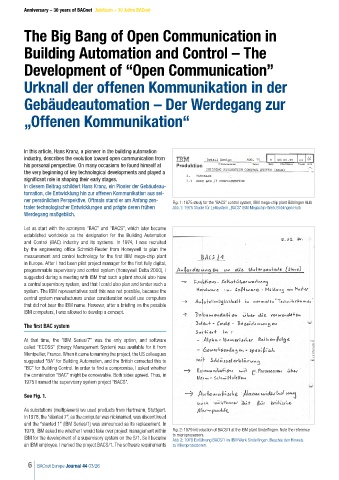
          ner persönlichen Perspektive. Oftmals stand er am Anfang zen-  Fig. 1: 1975 study for the “BACS” control system, IBM mega-chip plant Böblingen Hulb
          traler technologischer Entwicklungen und prägte deren frühen   Abb.1: 1975 Studie für Leitsystem „BACS“ IBM Megachip-Werk Böblingen Hulb
          Werdegang maßgeblich.

          Let us start with the acronyms “BAC” and “BACS”, which later became
          established worldwide as the designation for the Building Automation
          and  Control  (BAC)  industry  and  its  systems.  In  1974,  I  was  recruited
          by the engineering office Schmidt-Reuter from Honeywell to plan the
          measurement and control technology for the first IBM mega-chip plant
          in Europe. After I had been pilot project manager for the first fully digital,
          programmable supervisory and control system (Honeywell Delta 2000), I
          suggested during a meeting with IBM that such a plant should also have
          a central supervisory system, and that I could also plan and tender such a
          system. The IBM representatives said this was not possible, because the
          central system manufacturers under consideration would use computers
          that did not bear the IBM name. However, after a briefing on the possible
          IBM computers, I was allowed to develop a concept.

          The first BAC system

          At that time, the “IBM Series/7” was the only option, and software
          called “ECOSS” (Energy Management System) was available for it from
          Montpellier, France. When it came to naming the project, the US colleagues
          suggested “BA” for Building Automation, and the British corrected this to
          “BC” for Building Control. In order to find a compromise, I asked whether
          the combination “BAC” might be conceivable. Both sides agreed. Thus, in
          1975 I named the supervisory system project “BACS”.

          See Fig. 1.

          As substations (multiplexers) we used products from Hartmann, Stuttgart.
          In 1978, the “slanted 7”, as the computer was nicknamed, was discontinued
          and the “slanted 1” (IBM Series/1) was announced as its replacement. In
          1979, IBM asked me whether I would take over project management within   Fig. 2: 1979 introduction of BACS/1 at the IBM plant Sindelfingen. Note the reference
          IBM for the development of a supervisory system on the S/1. So I became   to microprocessors.
                                                              Abb 2: 1979 Einführung BACS/1 im IBM Werk Sindelfingen. Beachte den Hinweis
          an IBM employee. I named the project BACS/1. The software requirements   zu Mikroprozessoren.


           6  BACnet Europe Journal 44 03/26

