


Page 16 - 251119_BJ_ME-Journal_14_digital
P. 16
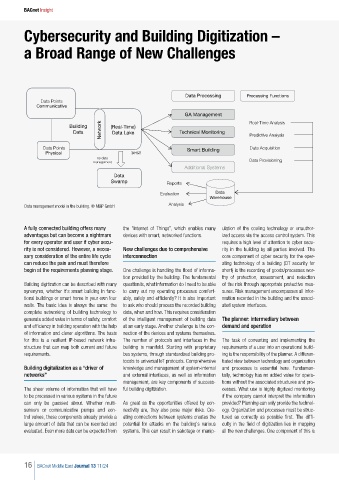
Technology
Internet Cloud-based
AI platform
Management BMS (Building
level LAN Management System)
Automation Controller
level Controller (manufacturer B)
(manufacturer A)
Field level
"communicative“component
„smart devices“
classical component
Fig. 2: Linking building automation with a (cloud-based) AI platform 1 Prof. Dr. Michael Krödel
“Unsupervised Learning” is used when determine the best way forwards in a hitherto efficiency can be established, but exploration
large quantities of data must be processed unknown situation, and conclusions drawn should continue to accommodate changes in
and categorized. This grouping enables the retrospectively. The learning task becomes more behavior and the environment.
recognition of deviations from norms and challenging when feedback is given much later
interdependencies. For example, sensor data from and hinges upon events in the relatively distant It can be seen that these three approaches are
identical circulation pumps can be grouped. If past. This is true in a human context, and equally complementary. The learning method should be
data from one pump or group of pumps deviates true in computer environments. chosen depending on the task in hand – each
from the norm, there may be a defect, and a has its merits.
human engineer can be sent to investigate. The best-known example in this category is
“Reinforcement Learning”. Consider the issue Concrete Applications
“Supervised Learning” often makes use of neural of determining the optimal start and stop times
networks. They consist of entry and exit nodes of heating to achieve a comfortable temperature Many diverse AI-based applications are available
as well as further nodes in the intermediate when the building opens. At the simplest level, in the field of building automation. They can be
layers. Mathematically weighted relationships the learning algorithm receives the value from broadly categorized as follows:
exist between the diverse nodes (neurons). In the room temperature sensor and can act on the
order to optimize these relationships, the neural actuator on the radiator. By a process of trial and Optimized facility management: needs-based
network is subjected to a training phase with error, the algorithm can determine the necessary control of heating plants, circulating pumps,
known input and output patterns. In the field lead time. However, this simple example ignores lighting etc. (as opposed to control on the
of building automation, for example, a neural the fact that, for instance, the speed of heating basis of simple parameters or by timer).
network can “learn” the current consumption also depends on the outside temperature, so Optimized utilization of spaces and
profiles of different appliances and which the reading from an exterior temperature sensor infrastructure: capacity analysis and
appliances are active when. This information needs to be considered. Instead of providing a forecasting, e.g. for meeting rooms,
can be used to avoid “spikes” in building energy pre-set target temperature, the algorithm may canteens, pantries, transit areas, toilets and
consumption, by shutting down some appliances be given evaluations (good / OK / cold) during the parking spaces as well as the provision of
and extending the operation time of others. day and must learn in response to this feedback. information in the short term (for building
occupants) and in the long term (for facility
Another form of Artificial Intelligence is In addition, the algorithm can be provided with managers, e.g. in form of advice on building
represented by processes that autonomously an additional rating every month based on restructuring).
determine which actions are appropriate in a the overall energy cost: encouraging efficient Load management: forward-looking
given situation. They emulate human behavior behavior and discouraging inefficient responses. operation of electrical systems in order to
whereby different solutions are tried in order to A “stable” response that balances comfort and avoid (costly) peak loads.
16 16 BACnet Middle East Journal 14 11/25

